Safety & PrivacyGuide
Is It Safe to Use ChatGPT and Claude with Company Data? A UK Business Guide
What UK businesses need to know before staff use AI tools with customer or company data: UK GDPR basics, business vs personal accounts and a simple AI policy.

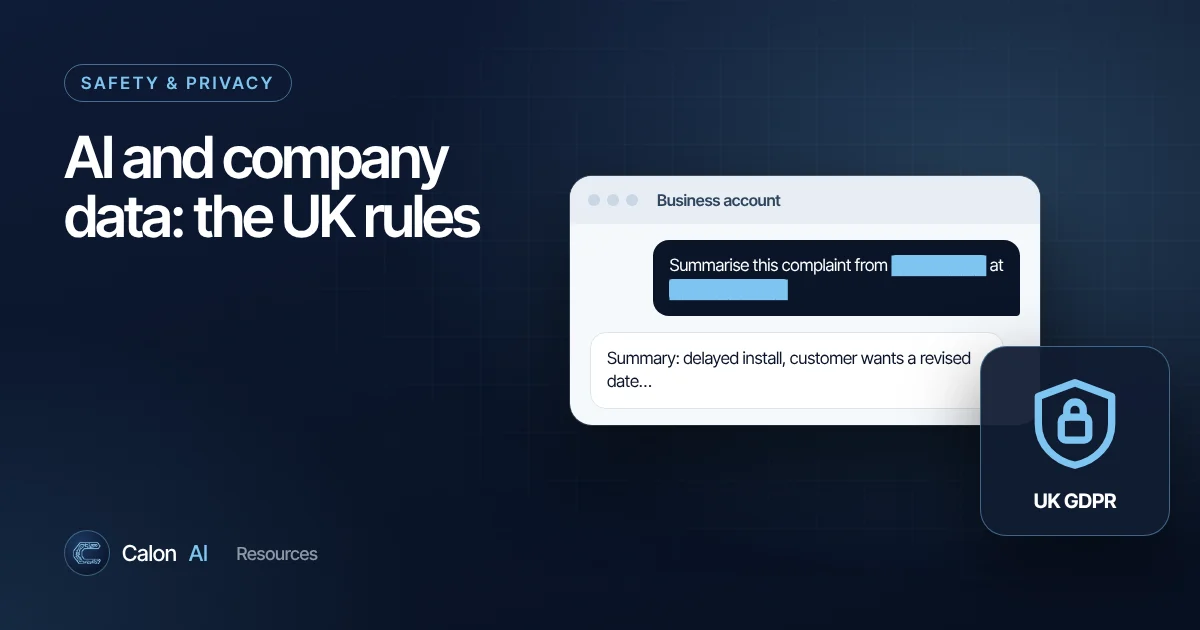
AI assistants are now part of everyday work, often before anyone has decided whether that is allowed. This guide covers what a UK business owner or manager needs to know to use AI tools safely, without needing a law degree. It is general information, not legal advice. For your specific situation, speak to a data protection professional.
The main risks, in plain English
- Personal accounts used for company work. You have no control over the account, its settings or what happens to the data when the employee leaves.
- Oversharing. Pasting a whole customer database or HR file when a few anonymised lines would do.
- Trusting wrong answers. AI can produce confident, plausible errors. Acting on them can harm customers or break rules.
- Automated decisions about people. Using AI to decide things that significantly affect individuals, such as rejecting applicants, triggers extra legal requirements.
- Connected apps. Linking an AI tool to email, files or your CRM gives it access to far more data than a single chat.
What UK GDPR means for AI use
UK GDPR and the Data Protection Act 2018 apply whenever you process personal data, and the ICO is clear that this includes AI systems. The ICO's guidance on AI and data protection is the authoritative source. The core principles still apply:
- Lawful basis: you need a valid reason under UK GDPR, such as legitimate interests or performance of a contract, for each use of personal data.
- Transparency: your privacy notice should explain, in plain language, that you use AI tools and for what.
- Data minimisation: use only the personal data you need. Often you can remove names and contact details before using AI at all.
- Accuracy: check AI outputs, especially anything recorded about a person.
- Security: use reputable providers, business accounts, strong authentication and access controls.
- Processor contracts: when a provider processes personal data for you, you need appropriate contract terms (a data processing agreement). Business plans typically offer one.
- International transfers: many AI providers process data outside the UK. Check the transfer mechanism in the provider's terms.
- Automated decisions: decisions made solely by automated means with legal or similarly significant effects on people need specific safeguards, including the right to human review. The Data (Use and Access) Act 2025 changed parts of these rules, so check the ICO's latest guidance before relying on automated decisions.
Business accounts versus personal accounts
This is the single biggest practical decision.
| Personal account | Business plan (e.g. ChatGPT Business, Claude Team) | |
|---|---|---|
| Who controls it | The individual | Your organisation |
| Training on your content | Depends on the user's settings | Not by default on major providers' business plans |
| Admin controls and SSO | No | Yes |
| Removing access when staff leave | Not possible | Yes |
| Data processing terms | Consumer terms | Business terms, typically with a data processing agreement |
For example, Anthropic's pricing page lists "no model training on your content by default" as a feature of Claude Team. OpenAI offers similar commitments on its business plans. Always read the current terms for the exact plan you buy, because they differ between plans and change over time.
A traffic-light guide for staff
Green: fine on an approved business account
- Drafting emails, posts and documents with no personal data.
- Summarising public information or your own internal procedures.
- Brainstorming, rewriting and formatting.
- Spreadsheet formulas and analysis of anonymised data.
Amber: allowed with care, minimum data only
- Customer emails, with unnecessary personal details removed.
- Analysing business data that includes some personal data, on an approved business account.
- Connecting the AI tool to company files or email, only when approved by the owner of the policy.
Red: not without a specific review
- Special category data: health, ethnicity, religion, biometrics, criminal records and similar.
- HR files, disciplinary matters and performance reviews about identifiable people.
- Bulk exports of customer databases.
- Using AI to make decisions about people without human review.
- Passwords, API keys and other credentials, ever.
A one-page AI policy template
Adapt this for your business.
AI USE POLICY  |  [Company name]  |  Owner: [name]  |  Reviewed: [date]

1. Approved tools: [e.g. Claude Team / ChatGPT Business] using your
   company login only. Do not use personal AI accounts for work.
2. Data: Do not enter special category data, HR records, passwords
   or bulk customer data. Remove names and contact details where
   the task does not need them.
3. Check everything: You are responsible for any AI output you use.
   Verify facts, figures and anything legal or financial.
4. Customers: AI may draft customer messages, but a person must
   review them before sending unless [owner] has approved an
   automated workflow.
5. Connected apps: Only connect AI tools to email, files or the CRM
   with approval from [owner].
6. Mistakes: If you think data was shared wrongly, tell [owner]
   immediately. We would rather know early.
When you automate with AI
Automated workflows, such as AI reading enquiries or documents and updating your systems, process more data, more often, with less human oversight. That raises the bar:
- Map exactly what personal data flows through each step and where it is stored.
- Use API access under business terms rather than consumer chat accounts.
- Log what the system does and keep a person responsible for it.
- Carry out a Data Protection Impact Assessment where the processing is likely to be high risk.
Calon AI is registered with the ICO and builds automation with data protection designed in from the start: business-grade APIs, minimal data, clear logging and human review where it matters. If you want a second pair of eyes on how your team uses AI, book a 15-minute call.
Frequently asked questions
Is it legal to put customer data into ChatGPT in the UK?
It can be, but UK GDPR applies. You need a lawful basis, must tell people how their data is used, should only use the minimum data necessary and must have appropriate contracts and safeguards with the provider. Using an approved business account with suitable data terms is the practical starting point.
Does ChatGPT or Claude train on my data?
It depends on the plan and your settings. Business plans from both OpenAI and Anthropic do not use your content for model training by default. On personal accounts, check the data controls in settings. Always read the current terms for the plan you use.
Do I need a DPIA to use AI?
A Data Protection Impact Assessment is required where processing is likely to result in a high risk to individuals. Many uses of AI with personal data, especially at scale or involving automated decisions, fall into that category. If in doubt, carry one out. The ICO publishes guidance and templates.
What should an AI policy for staff include?
Approved tools and accounts, what data can and cannot be used, the requirement to check outputs before relying on them, rules for customer-facing use, how to report a mistake and who owns the policy.
Sources and further reading
Calon AI Team
Calon AI is a Welsh AI and automation consultancy based in Caerphilly and at the University of South Wales. Our engineers build AI agents, automations and dashboards for founder-led UK businesses, and we write these guides from that hands-on work.
We check facts against official documentation and primary sources at the time of writing and update articles when products change. AI tools change quickly, so confirm prices and plan limits on the provider's own site before you buy.